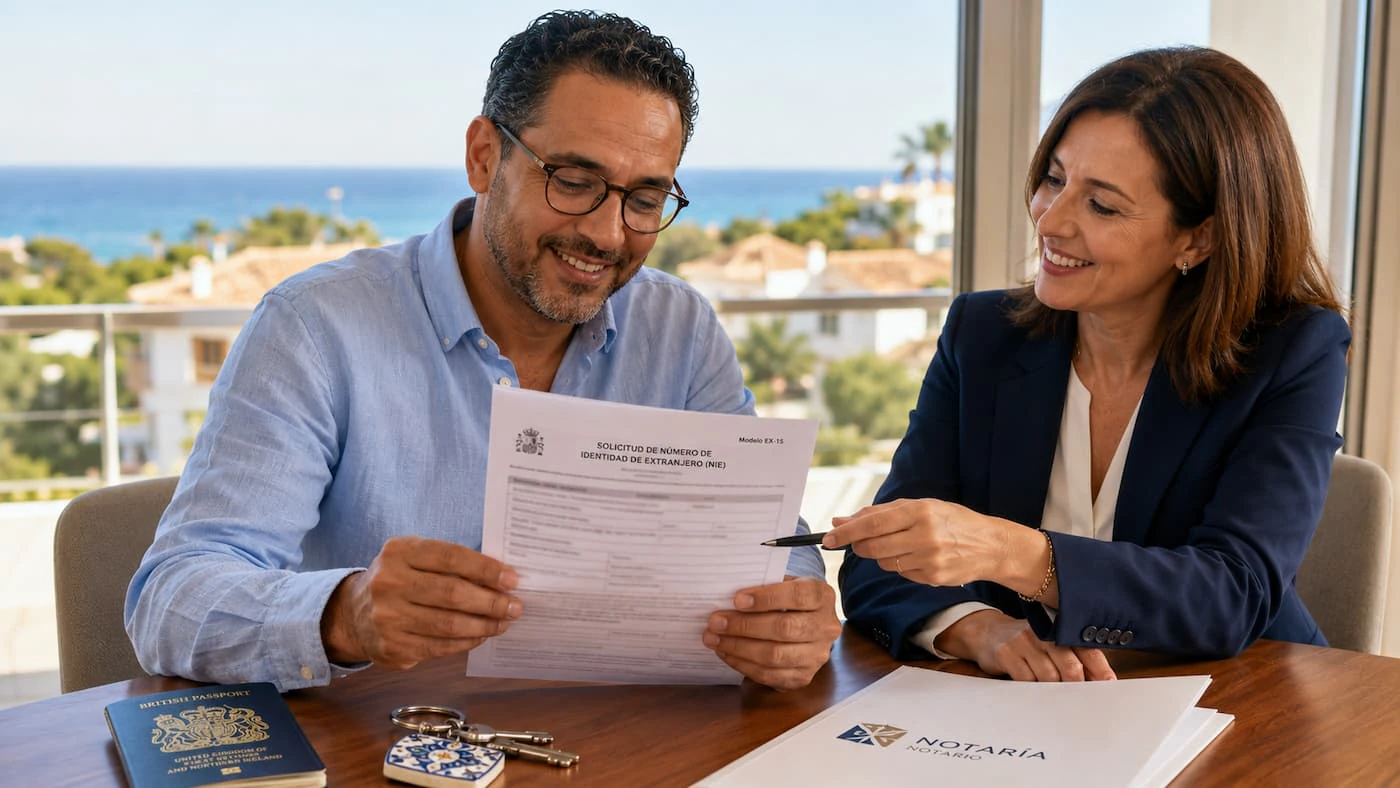
If you’ve been looking at the Spanish property market, chances are you’ve already run into an initial three-letter bureaucratic hurdle: the NIE.
The short, clear answer to your question is yes—it's absolutely mandatory. You can’t sign a purchase deed, open a bank account, or pay the corresponding taxes in Spain without this document.
Below, we offer an up-to-date, practical guide for 2026 so you can understand what it is, why you need it, and how to process it without wasting time or money in the process.
The NIE (Foreigner Identification Number) is a sequential, unique, and permanent code assigned to foreign nationals by the Directorate General of Police. It works as your fiscal identity signature in Spain.
Although the NIE doesn’t automatically grant legal residency, it’s the master key for any financial transaction. When you buy a home, you’ll need it for:
Signing the deposit contract or booking agreement for the property.
Setting up a mortgage with a Spanish financial institution.
Granting the public purchase deed before a Notary.
Paying the related taxes (such as ITP or VAT and IAJD).
Registering the property in your name in the Land Registry.
Registering utilities for water, electricity, and gas.
Important: The NIE doesn’t expire; it’s assigned for life. What may expire is the physical document (the white paper if issued temporarily), but the number remains the same.
Depending on your residency situation and where you’re from, there are two main routes:
This is the one you need if you’re buying the home as an investment, as a second residence, or before moving permanently. It identifies you for tax purposes but doesn’t authorize you to live permanently. This is the standard document for international buyers.
If you’re an EU citizen and you’re going to live in Spain for more than 90 days, or if you’re a non-EU national with a residence visa, you’ll get this format (a physical card or a green certificate).
You have two main options to file your application, depending on whether you’re in Spanish territory or in your home country.
This is the most recommended option if you’re not in a rush and want to arrive in Spain ready to sign.
Find the Spanish General Consulate that corresponds to your territorial jurisdiction.
Request an appointment through its website platform.
Submit the documentation in person or by mail (depending on the consulate).
If you’re already in the country or have a local advisor:
Access the Electronic Office of Public Administrations and request a Foreigner Appointment.
Select the province where you’ll buy the home and the procedure "Police—NIE Assignment".
Go to the assigned Police Station or Foreigner Office.
To prevent your application from being rejected, you’ll need to prepare a folder with the following documents (original and copy):
EX-15 Model Form: Completed and signed. You must tick the box for "Economic Reasons".
Full passport or identity document (DNI/Identity Card): It must be valid. If it’s a passport, you’ll need a copy of all pages.
Justification of the reason: For buying a home, the deposit contract works, as does a letter from the notary or a formal purchase offer.
Form 790 (Code 012): This is the proof of payment of the administrative fee (approximately €10). It must be paid at the bank before your appointment.
Timelines vary considerably depending on the route chosen and how busy the administration is:
Processing Route | Estimated Approval Time | Notes |
Spanish Consulate | 2 to 4 weeks | Depends on the country; application volume affects the appointment. |
Police Station in Spain | 1 to 5 business days | Delivery is usually immediate or within a few days after the appointment. |
With Notarial Power of Attorney | Same timeframe as in Spain | A lawyer or advisor handles it on your behalf without you traveling. |
Pro Tip: The biggest current bottleneck is getting the foreigner appointment in Spain. If the timelines of your deposit contract are tight, consider granting a Notarial Power of Attorney to a professional so they can carry out the procedure on your behalf.
You can start negotiations or sign an informal booking, but you can’t sign the public deed before a notary, nor can you pay the mandatory taxes without an assigned NIE number.
No. The NIE is an identifier. If you make a real estate investment equal to or greater than €500,000, you meet the requirement to apply for an investor residence visa (commonly called the Golden Visa), but the residency process is separate and comes later.
Technically, payments can be made from foreign accounts via regulated international transfers, but in practice, opening a bank account in Spain makes paying much easier—especially for taxes, notary cheques, and setting up future utility payments. To open this account, they’ll also ask for your NIE.
The property purchase process in a foreign country can be complicated if you don’t know how local administration works. Having expert support not only saves you weeks of waiting for an appointment—it also legally safeguards your investment from the very first moment.
If you want to process your NIE quickly or need comprehensive advice to buy your home with complete legal certainty, at Marina Digorn we help you manage every step of the purchase process without last-minute surprises. Contact us today.

