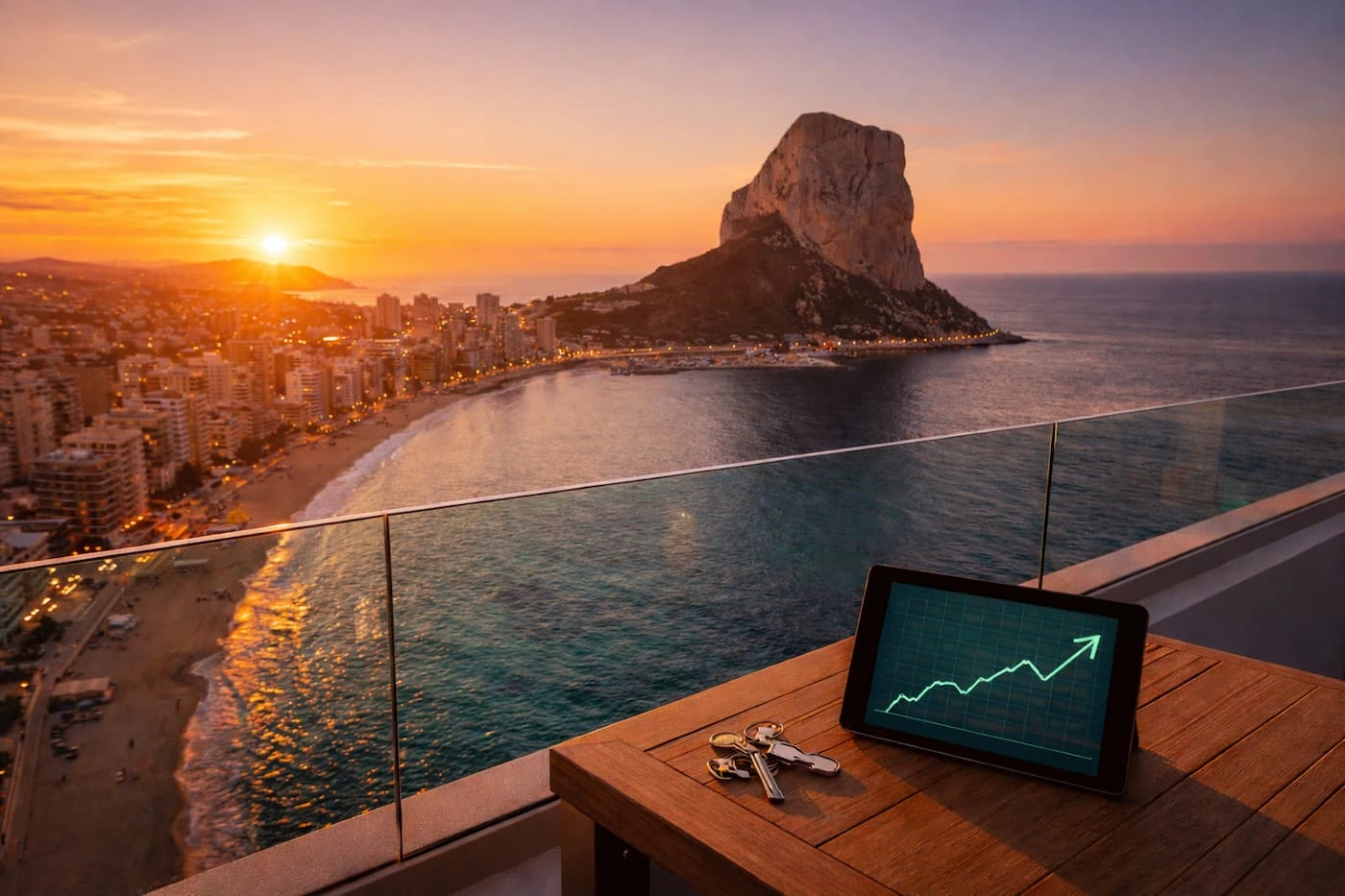
Investing in the real estate sector on the Costa Blanca is no longer a matter of “instinct” but a data-driven science. If you’re reading this, you’re probably wondering whether Calpe is still the safe haven it was decades ago, or if the market has hit its ceiling in 2026.
The short answer is yes—but under very specific conditions for segmentation and management. Below, we break down the figures, the areas, and the legal reality of tourist licenses in the municipality of Peñón de Ifach.
Calpe is more than just a holiday destination; it’s a hub for international investment. In 2026, demand remains robust thanks to the scarcity of buildable land and infrastructure that has managed to modernize without losing its maritime essence.
Over the past five years, the price per square meter in Calpe has seen steady growth of between a 4% and 6% year on year. Unlike other saturated spots along the coast, Calpe strikes a balance between luxury new builds and the resale market with high potential for renovation (house flipping).
This is the big question investors have. The choice depends on your risk profile and your ability to manage the property.
Calpe enjoys an average annual occupancy rate of over 70%, which jumps to 95% between June and September.
Gross Yield: It can range from the 7% to 10%.
Key Factor: Managing the Tourist License. Currently, Calpe Town Hall maintains strict but clear regulations. It’s essential to verify that the property complies with urban planning compatibility rules before purchasing.
Audience: Predominantly Central European tourism (Belgian, Dutch, and German) with high purchasing power.
An increasingly attractive option due to limited supply for local residents and digital nomads.
Gross Yield: Typically around the 4% - 5%.
Advantages: Lower tenant turnover, reduced maintenance costs, and greater stability of monthly income.
For a purchase in Calpe to be profitable in 2026, you need to focus on these three pillars:
Strategic Location: Properties in front-line position on Playa de la Fossa or the Arenal-Bol guarantee immediate liquidity. However, residential areas like Maryvilla or Canuta offer higher long-term appreciation margins.
Energy Efficiency: In 2026, homes with A or B energy certificates sell and rent about 15% faster. Sustainability is no longer a bonus—it’s a market requirement.
Post-Sales Services: The difference between a passive investment and a headache is having local partners like Marina Digorn to manage the asset end to end.
It’s not all sunshine and beach; the smart investor should anticipate:
Maintenance Costs: Being close to the sea means greater wear and erosion on the materials.
Tax Burden: It’s crucial to calculate the ITP (Transfer Tax) or the VAT on new builds to determine your net return (ROI).
Interest Rates: In the current 2026 landscape, bank financing requires a more rigorous leverage analysis than it did five years ago.
Buying in Calpe in 2026 is a great investment for profiles seeking security and recurring returns. The combination of a unique geographic setting, consolidated international demand, and a limited supply of new housing positions this municipality as a safe-haven asset amid the volatility of other markets.
If you’re looking for an asset that combines personal enjoyment with positive cash flow, Calpe is still the crown jewel of the Costa Blanca.

